April 17, 2026 - 2587 views
Written by Tina Houser
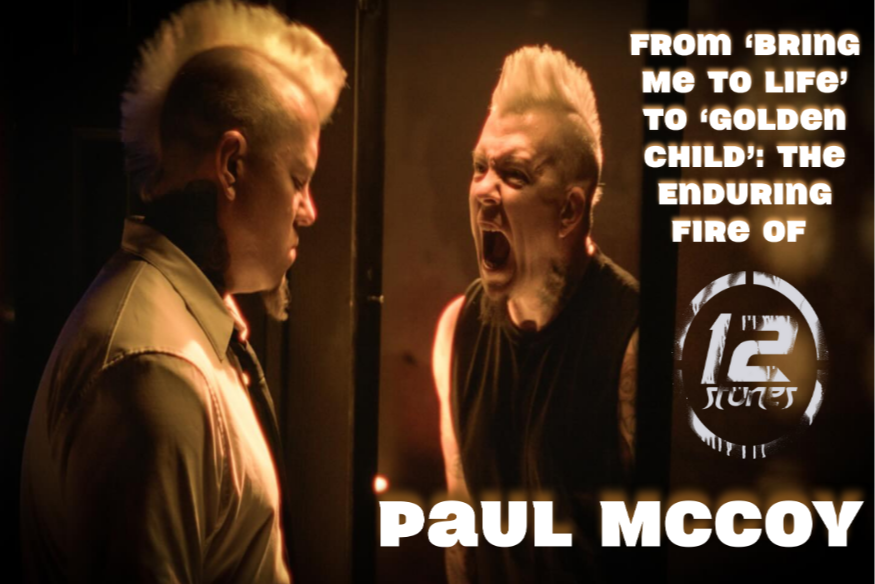
On Press Play Radio Conversations, McCoy sat down with Don and Tina not as a nostalgia act from the early-2000s alt-rock surge, but as a working artist still writing, still questioning, still carrying notebooks full of unfinished songs like a man who never stopped believing the next one might matter just as much as the last. Because for him, it always does.
That’s been true since the moment “The Way I Feel” quietly reshaped the trajectory of 12 Stones back in 2002. It wasn’t just a breakout track—it was the reason the band existed at all. McCoy still plays it every night, still believes in it, still hears the echo of the decision that changed everything when Diana Melcher refused to let the label pass on the song. Some tracks age. Others anchor a life.
But if McCoy’s story has a turning point etched into rock history, it came in the form of a chorus that would eventually reach 1.6 billion views and counting. When his voice cut through Amy Lee’s on Evanescence’s “Bring Me to Life,” it didn’t just introduce him to the world—it dropped him into the center of one of the most culturally defining rock songs of the 21st century. He wasn’t supposed to be on the track. He joked his way into the opportunity. Then he lived with the consequences of being the unexpected voice inside a global phenomenon that carried label politics and public misunderstanding along with its success.
For years, the narrative around the song followed him like a shadow. Only later did the conversations happen that allowed friendship and perspective to replace confusion. It’s the kind of story that only exists inside the machinery of rock music—the kind where a throwaway moment becomes destiny.
Still, McCoy has never sounded like someone chasing legacy. He sounds like someone chasing the next honest lyric.
He writes the old way. Pen. Paper. Guitar within reach. Songs arrive when they want to, not when the calendar says they should. Some riffs sit for decades waiting for the right melody. Others spill out in a single rehearsal, like “Anthem for the Underdog,” which essentially wrote itself the first time the band played it through. The difference between inspiration and patience, he knows now, is simply experience.
That patience extends to his view of technology, too. In a world increasingly fascinated with AI-generated music and algorithm-driven perfection, McCoy stands firmly in the imperfect human lane. He’s not dismissive—he’s cautious. There’s room for tools, he believes. But there’s no replacement for failing in front of nobody, for recording something raw and wrong, for learning what a song actually means by surviving long enough to sing it again.
He’s lived both sides of that truth.
He started performing professionally at 19. He’s 44 now. And somewhere between those years came sobriety, perspective, and the realization that his brain still thinks he’s 20 even when his body disagrees after a full set. Recovery time gets longer. High notes get riskier. But stepping onto a stage without a safety net is still the point.
“If I miss, I’m all the way missing,” he says with the calm confidence of someone who wouldn’t have it any other way.
That honesty runs through his catalog. Songs like “Adrenaline” weren’t written as anthems—they were written as survival mechanisms. He still calls live performances therapy sessions, whether they happen in front of two people or twenty thousand. And when audiences sing back words he wrote during darker seasons of his life, the exchange becomes something closer to communion than entertainment.
It’s why fans telling him a song helped them through something heavy still lands with weight. Not pressure. Responsibility.
McCoy grew up inside a religious household, but he never tried to define what his lyrics should mean for anyone else. When listeners hear God in a song, he lets them keep that interpretation. When they hear struggle, doubt, hope, or defiance, he lets that stand too. The meaning belongs to whoever needs it most.
That openness extends to his influences. He moved from Mississippi country roots to the emotional gravity of Alice in Chains, Soundgarden, and Pantera. What mattered wasn’t genre—it was authenticity. He’s always gravitated toward artists who sounded like they meant what they were saying.
It started, unexpectedly, with a Silverchair record handed to him in a Spanish class. Realizing those musicians were his age changed everything. One moment he was planning a future as a soccer player. The next he was blowing up his first amplifier and committing to music instead.
That’s how rock careers begin sometimes—not with strategy, but with recognition.
Even now, after arena tours with Creed and Nickelback, after opening sets played while audiences were still arriving from work, after festival crowds rumored to reach eighty thousand people, McCoy still talks like someone grateful simply to be invited back onto the stage again tomorrow.
He carries Louisiana with him wherever he goes—the humor, the superstition, the swamp-born storytelling instincts. He jokes about voodoo dolls when discussing “Voodoo Doll,” laughs about past haircuts that probably earned him a few enemies, and keeps his touring companions close—two loyal road dogs riding alongside him from venue to venue.
But if there’s a thread tying his story together right now, it’s momentum.
“Golden Child,” his latest release, isn’t nostalgia dressed as relevance. It’s a sharp reflection on the difference between who people really are and who we imagine them to be. In a hyper-visible era where everyone performs themselves online, McCoy is still writing about the emotional collisions that happen off camera. Relationships fracture differently when the myth of someone replaces the person standing in front of you. That tension fuels the next chapter of his songwriting—and there’s more coming.
The notebooks are full.
After twenty-five years in motion, McCoy still talks like a kid who just discovered that music could change his life in a Spanish classroom somewhere in Louisiana. He still believes songs matter. He still believes crowds matter. He still believes showing up matters—even when nobody’s there yet.
And that’s the real story of Paul McCoy.
Not the billion-view chorus. Not the arena lights. Not the festival stages.
It’s the voice that keeps coming back anyway.
To learn more about 12 Stones and Paul McCoy’s music, tour updates, and artist story, visit their official Press Play Mosaic profiles:
https://mosaic.pressplay.me/profiles/12-stones/v7 https://mosaic.pressplay.me/profiles/paul-mccoy/v7
Watch the full interview here: Still Singing Through the Noise: Paul McCoy of 12 Stones on Legacy, Longevity, and “Golden Child” - Press Play Radio





Comments(0)